
Marie Curie launch research into unscheduled care
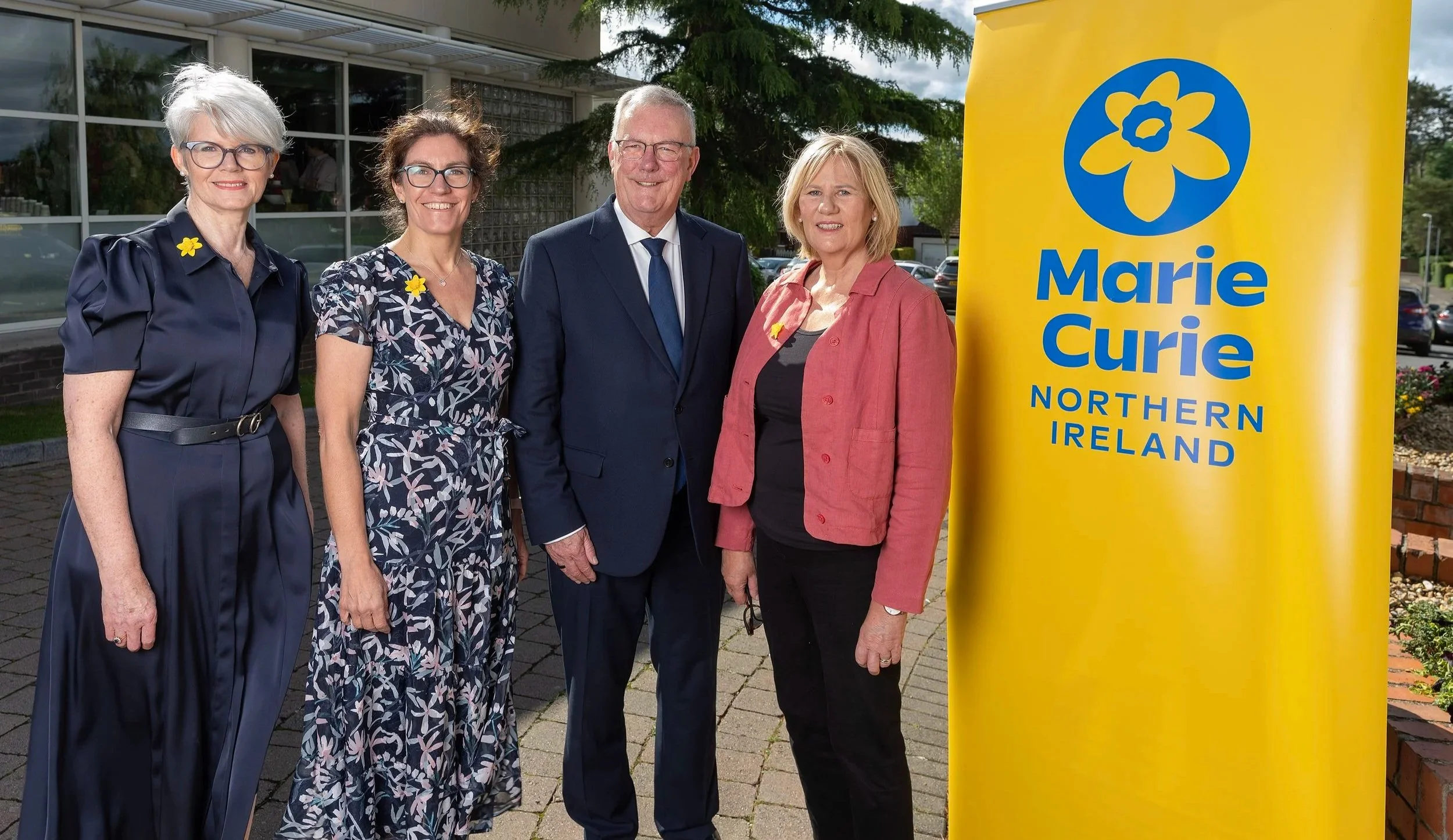
Pictured at the launch of the unscheduled care research with Health Minister Mike Nesbitt MLA are Marie Curie staff (L-R) Joan McEwan, Dr. Sarah Holmes and Paula Heneghan
Emergency departments becoming “default” for end of life care in Northern Ireland, Marie Curie warns
New research launched today [17 June] by the end of life charity, Marie Curie, reveals significant pressure on acute care services by people with a terminal diagnosis, with an estimated one in five calls to the Northern Ireland Ambulance Service (NIAS) relating to someone in their last year of life.
The studies, carried out by NIAS, Queen’s University Belfast and Ulster University, provide the first detailed picture of how people nearing the end of life in Northern Ireland rely on hospital, ambulance and emergency department (ED) services.
The research found that eight in ten people who were in their last year of life had at least one emergency department (ED) attendance (82%) and one emergency hospital admission (77%).
Of all ED attendances, two-thirds (68%) resulted in an emergency admission to hospital, while almost 60% were in the out-of-hours period.
End of life charity Marie Curie says the findings point to a system under immense strain where gaps in community care and limited access to support, particularly out-of-hours, are leaving many people at the end of life with no alternative but to call on emergency services in times of crisis.
Joan McEwan, Associate Director of Policy and Public Affairs at Marie Curie NI, said:
“This research paints a stark picture of how emergency services are frequently becoming the default response because people simply can’t access the help they need elsewhere.
“We know that most people living with a terminal illness would prefer to be cared for at home but without properly resourced services in the community, families and healthcare professionals are left with little choice but to call an ambulance or turn to ED.
“End of life is already an incredibly difficult and stressful time for patients and their carers. Having to seek help in a busy emergency department can add additional distress – especially when, with the right community care, it could often be avoided.”
Tasha from Co. Fermanagh cared for her dad who was diagnosed with liver cancer and later, hepatic encephalopathy (HE):
“Dad had been having treatment for liver cancer, but he started having a very bad reaction to his treatment with spells of serious confusion and even total blackout. The first time it happened, I was worried that he might be having a stroke but then it started to happen quite regularly, and we’d frequently have to call for an ambulance. It got to the stage where we were having to call for an ambulance nearly once a week.
“The ambulance service themselves were fantastic - calming, reassuring, and spoke to my dad in a way that got him to go to hospital as I know he would have been reluctant otherwise - but it seemed that we constantly had to repeat his diagnosis, treatment, and what had been happening on a regular basis. No-one seemed to have access to his records, and awareness of the situation was limited.
“When we’d get to ED, there were always a lot of conflicting answers about what his condition could be. Then there would be shift change, and you’d be no further on. We tried to get a care package for him in the community so that he could be looked after at home but there wasn’t anything available. He was admitted to hospital and died there two months later.”
The research also highlights the challenges faced by paramedics responding to end of life patients.
In a survey of NIAS paramedics, over half (58%) said they “rarely” or “never” knew in advance that they were attending a patient nearing the end of life, limiting their ability to plan and deliver appropriate care.
Jade Hunter, Trainee Advanced Paramedic in Urgent Care at NIAS, said:
“As paramedics, we are often caring for patients at the end of life without knowing in advance that they are receiving or should be receiving palliative care. Combined with limited access to anticipatory drugs, difficulties accessing advice and support, and a lack of referral pathways to community services, particularly out of hours, this can make it challenging to deliver compassionate and patient-centred care.
“By understanding and addressing these barriers, we can better support patients, their families and loved ones. As paramedics, we want to provide the best possible care to our patients; although we cannot "fix" it for them, we can support a compassionate and dignified death that aligns with their wishes.”
Marie Curie is warning that due to Northern Ireland’s ageing population and increasing need for palliative care, pressures on emergency services are likely to intensify without urgent action. A previous report by the charity revealed that almost 1 in 3 people are currently missing out on the end of life care and support they need.
The charity is calling for increased investment in community-based palliative and end of life care services, better coordination across all parts of the system and greater support and training for frontline staff.
Joan McEwan continued: “Without urgent reform to our health and social care system that provides more community support and better integration of care, more people will continue to spend their final months of life in emergency settings. This is often an appalling experience for patients and families, which places an unnecessary burden on our frontline staff who are already under pressure, and costs the NHS significantly more than if care was provided in the community. “This research demonstrates that now is the time to act and provide the support that patients at the most vulnerable stage of their lives desperately need. No one should spend their final days in crisis when they could be cared for with dignity at home.”